Is textured greaseproof paper the same as parchment paper?
No. It looks like parchment because of the mottled tint, but it is a greaseproof serving sheet, not a silicone-coated baking parchment for lining pans.
Textured greaseproof paper is a grease-resistant sheet with a mottled, parchment-style surface in a warm oatmeal or golden tone. It dresses a cheese board, a bread basket or a pizza box while doing the same hold-out job as a plain sheet.
From $0.30 a sheet. Written quote in one business day and a free design proof; the exact number depends on size, ink count and quantity.
From $0.30 a sheet. Exact price on the written quote.
| Base sheet | Tinted greaseproof, mottled parchment look |
|---|---|
| Tones | Oatmeal (light tan) or golden (warm yellow) |
| Typical weight | About 30–40 lb; 18 × 24 in sheets run heavier |
| Heat | Dry heat to about 400°F (typical); fine under a pizza |
| 1–2 dark food-safe colors recommended; up to 4 possible | |
| Packing | Flat, 500 to a ream, 1,000 to a case |
Textured greaseproof paper is a tinted grease-resistant sheet with a soft, mottled finish that looks like old parchment rather than flat white paper. The texture is in the tint, not the surface, so the sheet is still smooth to the touch and prints cleanly. It is the sheet to pick when the paper is meant to be seen on a board or in a basket.
| Format | Typical size | Typical use |
|---|---|---|
| Sheet | 8 × 8 in | Pastry and cookie wrap |
| Sheet | 12 × 12 in | Bread and sandwich wrap |
| Sheet | 12 × 16 in | Tray liner |
| Sheet | 18 × 24 in | Full sheet pan liner |
Sizes are typical starting points. Any other size is a custom cut; ask on the quote. Full sheet and roll size chart.
Choose a sheet from this paper's photos, place your logo and send the mock with your quote request.
Upload your logo to place it on the paper
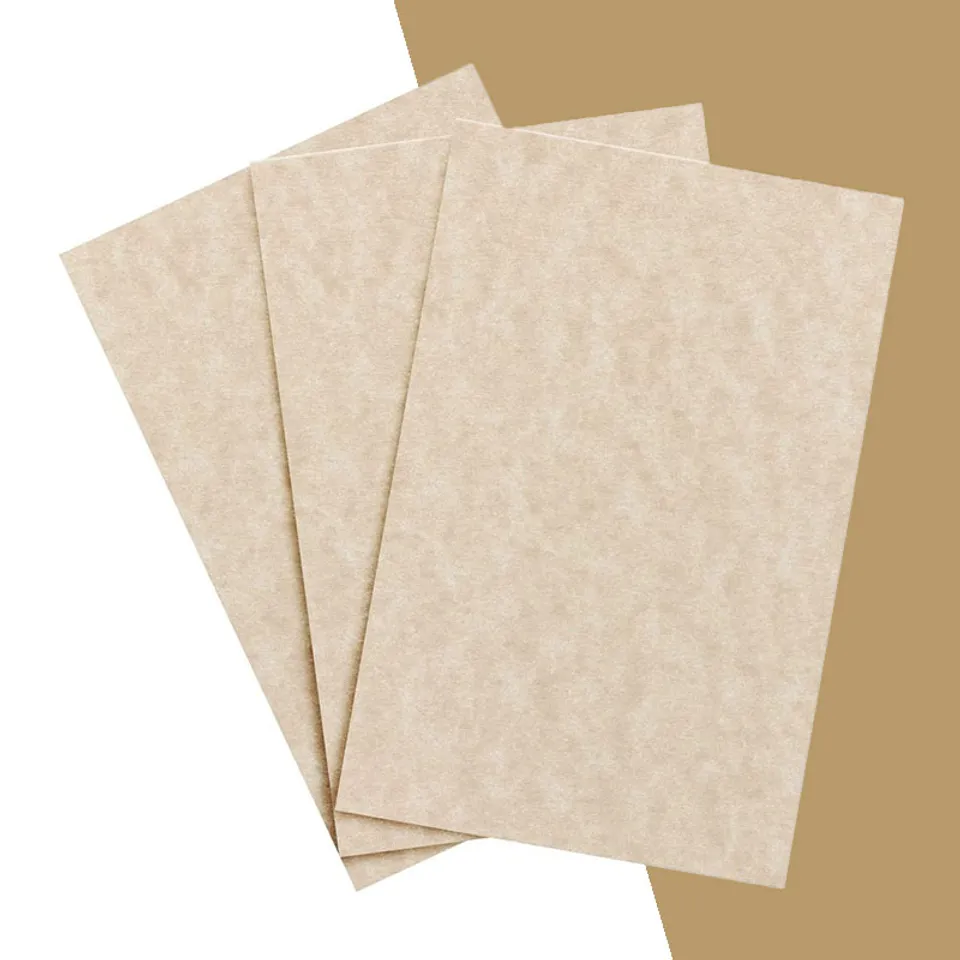
The two photos on this page show the stock without any print. The first is the oatmeal tone: three sheets in a light tan with a soft, cloudy mottle across the face. The second is the golden tone, a warmer yellow with the same drift of light and dark patches.
That mottle is a tint effect, not a raised texture. Run a finger over the sheet and it feels as smooth as any greaseproof. The eye reads it as parchment, which is the point.
The sheet is otherwise a standard grease-resistant paper. It holds oil, folds with a crease and shrugs off a hot pizza base.
Cheese shops lay a sheet under a wedge on a board so the wood stays clean and the display looks finished. Bakeries line bread baskets with it. Pizzerias drop a sheet in the box so the slice lifts out without pulling the base.
Steak houses and gastropubs use the 12 × 16 in sheet under a cut on a wooden board, and the golden tone looks right next to seared meat.
Charcuterie caterers like the 18 × 24 in size as a board cover. It takes a one-color mark in one corner and the rest of the sheet stays open for the food.
If your paper is going to be photographed, this is the sheet. Plain white reads as packaging; the mottled tone reads as part of the plate.
Yes. The grease hold-out comes from the dense fiber of the base paper, and the tint sits on top of that. A slice of pepperoni pizza on the golden sheet leaves an oil mark on the face but nothing on the box below.
The one difference is appearance. An oil spot on a mottled sheet blends into the pattern. The same spot on white paper shows as a dark ring. That is why delis that serve oily food often prefer this stock.
Moisture behaves the same way as on any greaseproof. Wet food will soften the sheet over an hour, so it is a serving paper, not a storage paper.
For the full story on hold-out versus coatings, the guide comparing greaseproof paper with wax paper lays it out.
Textured paper is usually seen flat, so measure the surface it will sit on rather than the food. Add an inch each side if you want the edge to show under the item.
| Typical size | The usual job |
|---|---|
| 8 × 8 in | Under a single cheese wedge, a pastry on a plate, a slice on a small board |
| 12 × 12 in | Round bread baskets, 10 in pizza boxes, cheese counter sheets |
| 12 × 16 in | Steak boards, deli platters, 12 in pizza boxes with overhang |
| 18 × 24 in | Charcuterie boards, sharing platters, full bakery display trays |
Any other size is a custom cut, and we cut to your board if you send the measurements. The sheet and roll size chart explains how to measure a board with a lip.
The oatmeal tone is the quieter of the two and sits well with dark wood, slate and kraft boxes. The golden tone is warmer and suits bakeries, pizzerias and anything served on light wood.
Both tones vary slightly from sheet to sheet by design. If you want every sheet identical, this is the wrong stock and a plain tinted sheet would serve you better.
A dark ink in one color prints best. Black, espresso brown, deep green or burgundy sits on either tone and stays legible across the mottle. A mid-tone ink such as orange or sky blue fights the background and looks faded.
We match to Pantone solid-coated swatches, but the tint underneath shifts every color a little warmer. The proof shows the ink on the tone you picked, not on white, so what you approve is what prints.
Fine detail is the main limit. Thin script, hairline borders and small reversed-out type break up against the pattern. Keep lines above 0.75 pt and type above 8 pt on this stock.
The guide to printing on greaseproof paper covers file formats and ink limits in more depth.
On textured paper less is more. A single logo in one corner, about 1.5 to 2 in wide, is the choice for boards and platters. The rest of the sheet shows the parchment look that you paid for.
A scattered repeat works on the 12 × 12 in cheese sheet, where the paper gets folded around the wedge and a corner mark might end up hidden. Keep the marks small and the gaps wide.
A full all-over pattern is possible but rarely worth it. It covers the mottle, and at that point a plain white sheet printed in a tan flood would look the same for less fuss.
Under a heat lamp, yes, without a second thought. Typical grades handle dry heat to about 400°F, so a sheet under a plated steak that sits at the pass is fine.
In the oven, it is a liner, not a baking sheet. It will take a reheated slice or a warm loaf on a tray. It is not sold as parchment for lining a cake pan. Ask about tray and air fryer liners for that job.
Cold is no issue at all. The sheet goes into a display fridge under cheese and comes out unchanged.
Sheets arrive flat, 500 to a ream and 1,000 to a case. Keep the ream in its wrap until it is needed. The tinted face shows a mark from a damp counter more than white does.
Do not fold the 18 × 24 in sheet to fit a drawer. The crease shows as a pale line across the mottle and it will not lie flat again.
Do not print a light logo on the golden tone. Cream, yellow and pale gray vanish. If your brand mark is light, reverse it out of a dark block instead.
Do not expect two orders months apart to match to the shade. The tint is a trade-standard range, and a slight drift between runs is normal.
What buyers ask before a first order. Type a word to filter the cards, or open one to read the full answer.
No. It looks like parchment because of the mottled tint, but it is a greaseproof serving sheet, not a silicone-coated baking parchment for lining pans.
Yes, by design. Each sheet has its own drift of light and dark patches, so no two look identical, which is what gives the parchment effect.
Yes, and dark is the right choice. Black, brown, deep green or burgundy stay legible across the mottle; pale inks fade into it.
It covers most sharing boards up to about 16 × 22 in with an inch of overhang.
It covers most sharing boards up to about 16 × 22 in with an inch of overhang. Send your board size if it is larger and we cut to fit.
No. The surface is smooth and dense, so a wedge of brie or a soft goat cheese lifts off clean after a day under the display counter.
Yes. The 12 × 12 in sheet lines a 10 in box and the 12 × 16 in gives overhang in a 12 in box.
Yes. The 12 × 12 in sheet lines a 10 in box and the 12 × 16 in gives overhang in a 12 in box. The slice lifts out without pulling the base.
An oil mark forms, but it blends into the mottle instead of showing as a dark ring.
An oil mark forms, but it blends into the mottle instead of showing as a dark ring. That is one reason delis prefer this stock for oily food.
No. The textured stock comes in the oatmeal and golden tones shown in the photos.
No. The textured stock comes in the oatmeal and golden tones shown in the photos. A plain white sheet is a different product with a flat finish.
Yes. Plain sheets in either tone are quoted the same way, 1,000 sheets per size, with no proof stage.
No. The tint is in the paper, not on it, so the sheet creases and tucks the same as a plain greaseproof of the same weight.
About the same at 30 to 40 lb. We put the 18 × 24 in board covers at the heavier end so they lie flat without curling.
Yes, as two runs of at least 1,000 sheets each on one quote.
Yes, as two runs of at least 1,000 sheets each on one quote. Each tone is its own stock, so they are cut and printed separately.
No match. Ask us on WhatsApp or call (503) 461-4788.
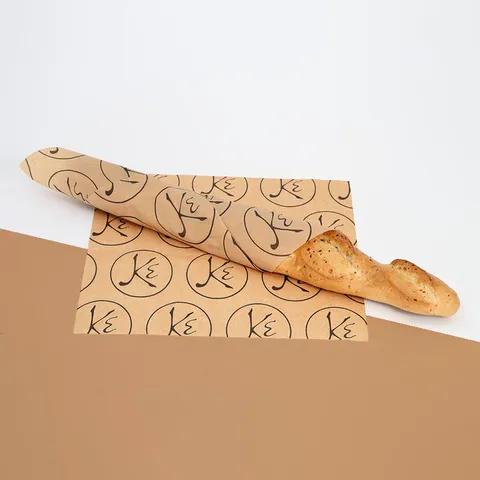 Custom Printed Greaseproof SheetsFrom $0.30 a sheet10 × 10.75 in · 12 × 12 in · 12 × 16 inLogo wraps for hot foodSee this paper
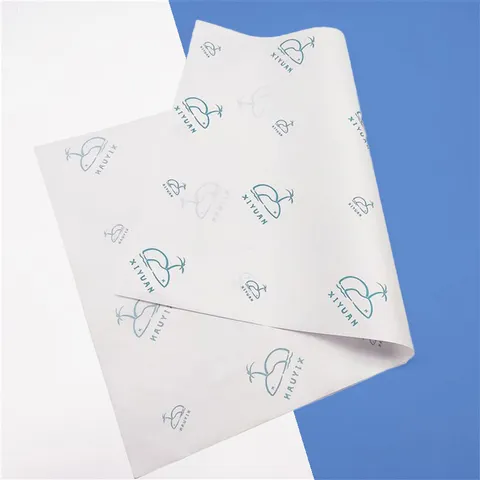 Greaseproof Basket LinersFrom $0.30 a sheet10 × 10.75 in · 12 × 12 in · 12 × 16 inFry baskets, trays and platesSee this paper
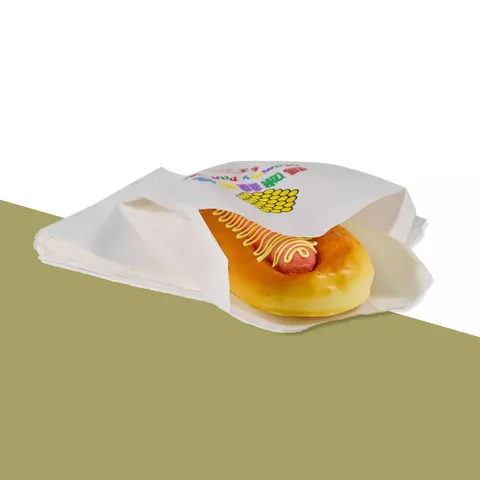 Burger Wrap PaperFrom $0.30 a sheet10 × 10 in · 12 × 12 in · 14 × 14 inBurgers, chicken sandwiches, wrapsSee this paper
 Glassine Paper RollsFrom $0.30 a sheet12 in × 500 ft · 15 in × 500 ft · 18 in × 1,000 ftInterleaving, coffee and retail linersSee this paper
Send the paper, a size and a quantity, plus a logo if you have one. We reply in writing within one business day with a price and a free design proof. Prefer to talk? Call (503) 461-4788 or message us on WhatsApp.