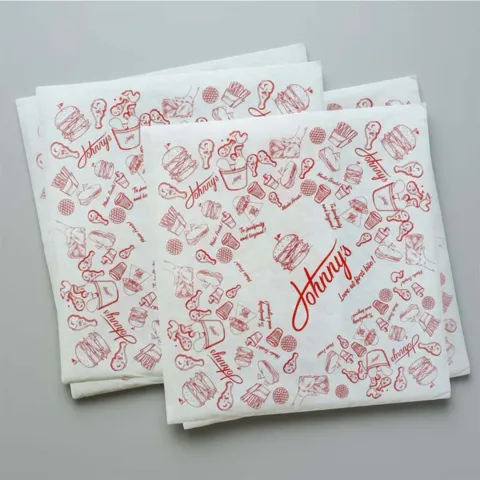
What a custom printed greaseproof sheet does
A printed greaseproof sheet is the plain workhorse of a deli counter. It is a flat piece of grease-resistant paper, cut to a fixed size, with your logo on it.
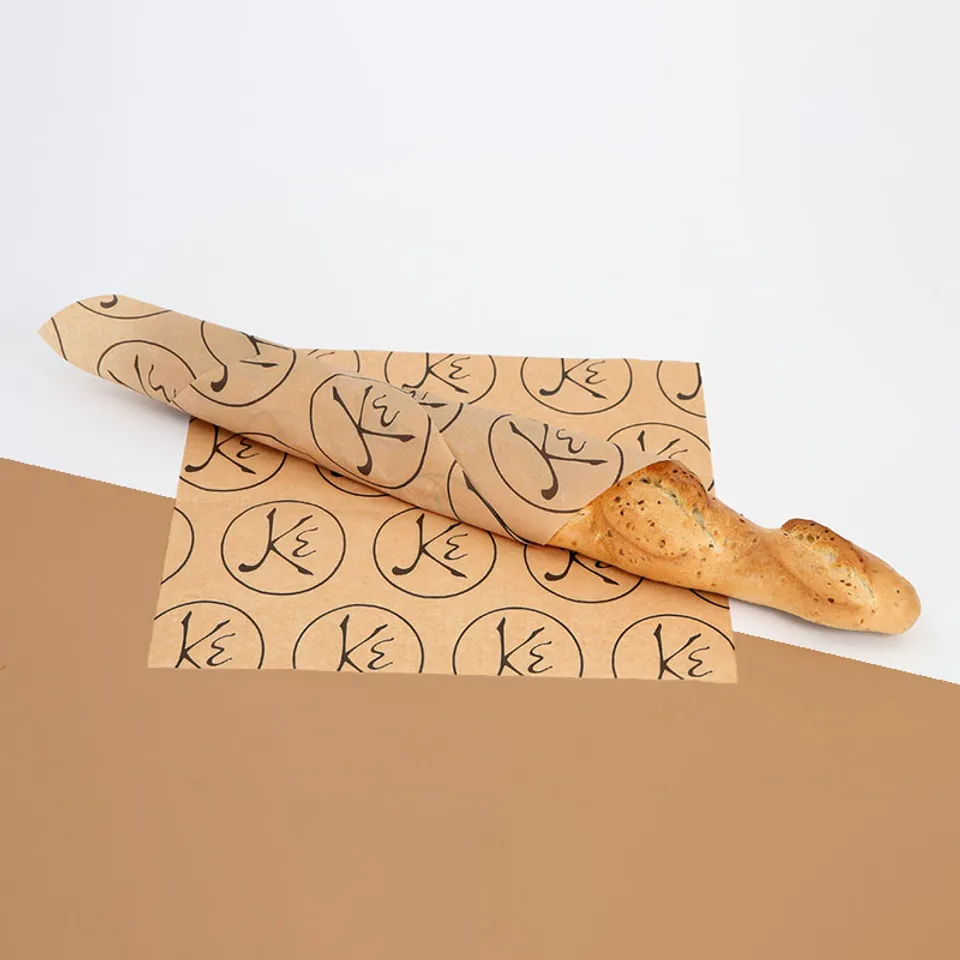
The first photo on this page shows the idea. A kraft sheet carrying a one-color monogram repeat wraps a baguette, rolls over itself and tucks. No tape, no sticker.
Delis, bakeries, sandwich counters and cafés use these sheets more than anyone. Butchers lay them under a cut on the scale. Cheese shops fold them around a wedge so the rind never touches the bag.
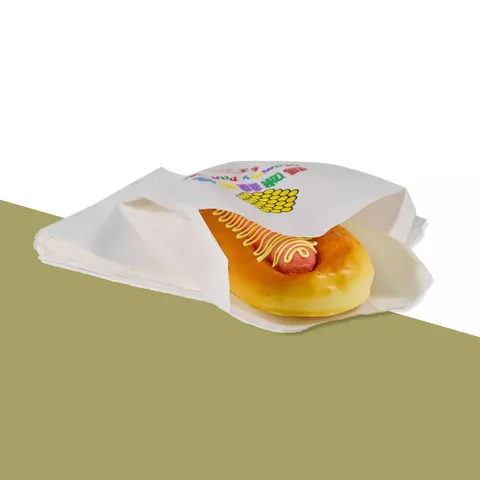
The second photo shows the same kind of paper in white, folded as a pocket around half a sandwich. That pocket fold is where most buyers start.
How the paper handles butter, oil and steam
Greaseproof paper works because its fibers are beaten tight and pressed dense. Oil cannot find a path through, so a buttered roll leaves no dark bloom on the outside of the wrap.
Steam is a different matter. A hot panini wrapped tight will sweat, and the paper lets that vapor out slowly instead of trapping it. The crust stays crisp longer than it would in foil.
The sheet folds cleanly along a crease and holds it. That matters for a baguette, where the paper rolls three times and the last turn has to stay tucked under its own weight.
Under a heat lamp the sheet takes dry heat well; typical grades are fine to about 400°F in an oven. Keep it away from an open flame and the edge of a flat-top.
Which sheet size fits a sandwich, a baguette or a pastry?
Measure the item, then add enough paper to fold twice. For a sandwich half that means a sheet roughly three times the width of the bread.
| Typical size | What it wraps or lines |
|---|
| 10 × 10.75 in | Half sandwiches, croissants, scale sheets for cheese and sliced meat |
|---|
| 12 × 12 in | Full sandwiches, bagels, wraps folded into a pocket |
|---|
| 12 × 16 in | Baguettes, hoagies, tray and board lining |
|---|
| 15 × 15 in | Large rolls, pastry boxes, platter lining |
|---|
Those four are the usual picks. Any other size is a custom cut, and a sheet cut to your tray saves trimming by hand every morning. The sheet and roll size chart shows how to measure before you ask.
Kraft or white, and which weight
Kraft greaseproof is unbleached and brown. It hides a grease shadow better than white and suits bakeries and delis that want a rustic look. White greaseproof is bleached and gives a cleaner surface for a second or third ink.
Weight is about feel and stiffness. A light 25 lb sheet drapes around a croissant and tears easily on a busy counter. A 40 lb sheet stands up as a tray liner and folds with a sharp edge.
- Light, about 25–30 lb: pastries, cookies, scale sheets, anything handled once.
- Standard, about 32–38 lb: sandwich pockets, baguette wraps, most printed jobs.
- Heavy, about 40–45 lb: tray and board liners, wraps that travel in a bag for twenty minutes.
If you are torn between two weights, go heavier for anything that leaves the shop in a bag. The guide to choosing a greaseproof paper weight walks through the trade-offs.
How many ink colors should a greaseproof sheet carry?
One color on kraft is the safest print there is. Black, dark brown or deep red sits on the brown fiber and reads from across the counter. The sample sheet in the first photo is exactly that: one black ink, one mark, repeated.
Two colors on kraft look muddy unless one of them is very dark. Save pastels and light tints for white stock, where they print clean.
Three and four color jobs print well on white greaseproof, and we match solid colors to Pantone solid-coated swatches. Expect a small shift on kraft, because the brown base tints every ink laid over it.
All inks are food-safe soy or water-based. They dry matte, not glossy, and they will not rub off onto a warm roll.
Single logo or step-and-repeat?
A step-and-repeat pattern tiles your logo across the whole sheet at a set spacing. However the sheet is folded, some part of the mark shows. That is why the repeat is the usual choice for wraps that get rolled or bunched.
A single centered logo works when the sheet lies flat: a tray liner, a board under a slice of cake, a scale sheet. Fold that same sheet around a sandwich and the logo may end up on the underside.
A good compromise is a small logo repeat with wide gaps. It keeps most of the paper plain so the food shows, and the mark still lands on the top face.
Artwork notes before we send the proof
We make a free design proof before anything prints, and you can change it as many times as you like. A few things get the first proof closer to right.
- Send a vector logo (AI, EPS, SVG or PDF) rather than a screenshot; lines under 0.5 pt fill in on greaseproof.
- Give us Pantone numbers if you have them; if not, we pick the nearest solid-coated match and show it on the proof.
- Tell us how the sheet will be folded so we set the repeat spacing to land on the top face.
- Keep text above 7 pt; the surface is slightly open and tiny type softens.
- Leave about 0.25 in clear at the sheet edge; the cut is accurate but not to the hair.
No artwork yet? The Design Your Greaseproof Paper studio places a logo on a sheet and shows the repeat before you ask for a quote.
Packing and how the sheets sit on the counter
Sheets ship flat, ream-wrapped in 500s, in cases of 1,000 or more. Flat packing matters: a greaseproof sheet that arrives curled will not lie still on a counter.
Most counters keep a ream in a shallow box or a pull-out drawer by the slicer. A 12 × 12 in sheet fits a standard sheet dispenser. The 12 × 16 in and 15 × 15 in sizes usually live in an open box.
Banding is an option for wet rooms. Ask on the quote if you want the sheets paper-banded in 250s so an open ream does not pick up moisture.
What goes wrong with printed deli sheets?
The most common mistake is ordering a sheet too small for the item. A 10 in sheet around a 7 in sub leaves nothing to tuck, so the wrap springs open in the bag.
The second is printing a light color on kraft. A cream logo on brown paper vanishes at arm's length.
The third is approving a proof with a flat logo for a sheet that will be rolled. Check the proof with a real sandwich in mind, not a flat screen.
Last, do not order a light pastry sheet for a hot, dressed sandwich. Oil in volume wants a heavier, high hold-out grade.
How to order printed greaseproof sheets
- Tell us the size, the stock (kraft or white), the weight and the quantity, with 1,000 sheets as the minimum run.
- Attach your logo and any Pantone references, or describe what you want and we draft it.
- We send a written quote within one business day. Nothing is guessed; the quote is the price.
- Approve the free design proof, or send edits until it is right.
- Production takes 4 to 6 business days after proof approval, then free tracked delivery in the US in 2 to 3 business days.
- Check the case on arrival. If a sheet is misprinted or a case is crushed, send photos inside 10 days and we reprint or refund.
Payment is by invoice once you approve the quote and the proof. Start with the written quote request form and we take it from there.