Pre-formed liners for baskets, trays and countertop ovens
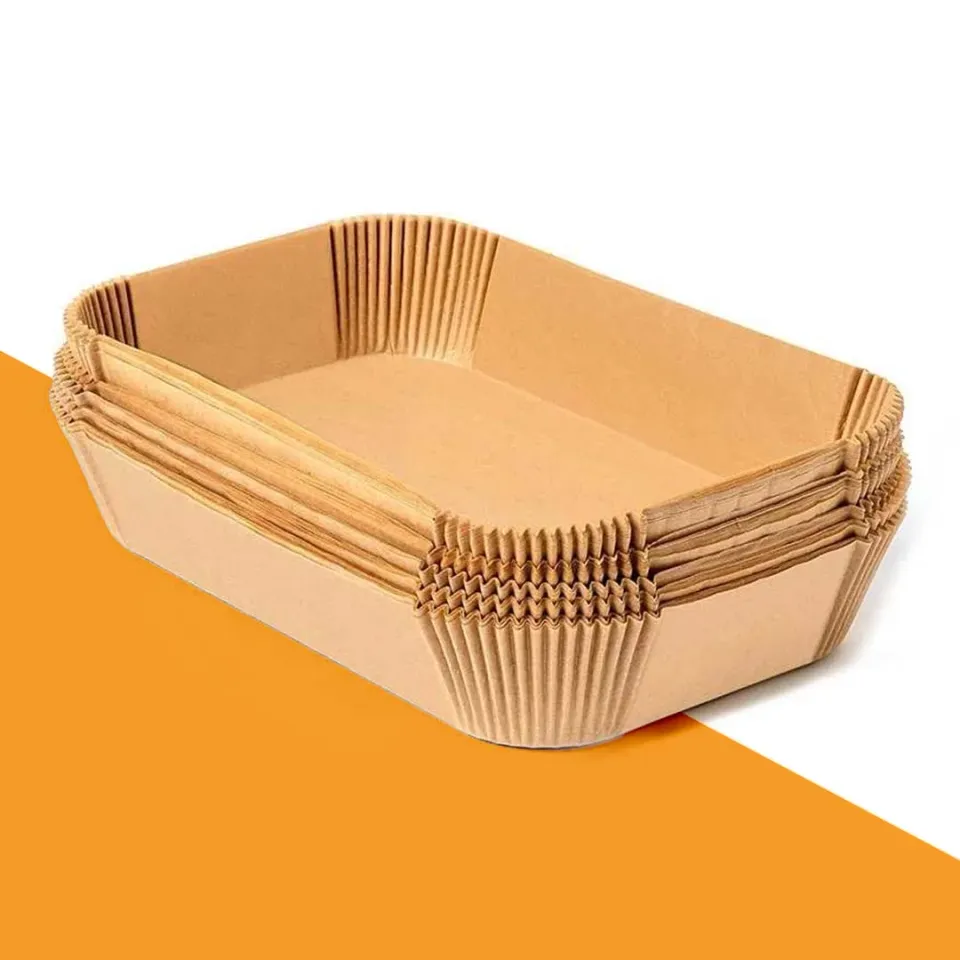
These are greaseproof paper trays with walls already formed, so there is no folding on the line. The square ones have a crimped rim all round and drop into an air fryer basket. The rectangular ones have pleated corners and sit in a sheet pan or an oven tray.
Cafés, food trucks, ghost kitchens and delis run them under wings, fries, roasted vegetables and reheated pastries. Bakeries use the 9 × 13 in size for brownies and bar cookies. Caterers use the 12 × 16 in rectangle for sheet-pan roasting.
The photos show nested stacks of kraft squares and rectangles, a square liner in a fryer basket with wings on lemon slices, and a burgundy rectangle made on colored stock.
Which liner size fits my air fryer basket?
Measure the floor of the basket, not the rim. Baskets taper, and a liner that matches the rim will crush its walls going in and block the air gap at the sides.
| Typical liner | Where it usually fits | What cooks in it |
|---|
| 6.5 × 6.5 in square | 4–5 qt basket fryers, single drawers | Wings, tots, fish fillets |
|---|
| 8 × 8 in square | 6–8 qt baskets, larger single drawers | Fries for two, reheated pizza slices |
|---|
| 9 × 13 in rectangle | Quarter-sheet pans, brownie pans, toaster ovens | Brownies, bar cookies, roasted vegetables |
|---|
| 12 × 16 in rectangle | Half-sheet pan floors, large countertop ovens | Sheet-pan chicken, trayed pastries |
|---|
Dual-drawer fryers usually take the 6.5 in square or a custom rectangle matched to the drawer floor. Oven-style air fryers with racks take the 9 × 13 in rectangle on the lowest rack. Anything else is a custom cut; send the floor measurement and we will size it.
Do air fryer liners block the air flow?
Not when they are used with food in them. The walls stop below the basket rim, so hot air comes over the top and down onto the food, and the holes in the basket floor under the liner do no work anyway once fat has pooled.
The problem case is an empty liner. With nothing holding it down the fan lifts it, and it can touch the element above. Load the food first, then start the fryer, and never preheat with the liner inside.
Crisping is about the same as bare basket for wings and fries. Items that need air underneath, like breaded cutlets, can be flipped halfway, which is what you would do anyway.
How the paper handles hot fat
Greaseproof stock holds rendered chicken fat and frying oil in the tray rather than letting it soak through to the basket. A standard batch of wings leaves a shine on the paper and nothing underneath.
Oven-safe grades handle up to 400°F, which is the top setting on most countertop fryers. The paper browns a shade at the crimped rim on a long run and stays flexible, so the liner lifts out by its corners with the food still on it.
Sugar is the exception. Glazed items such as honey wings caramelize onto the base, and the liner should go straight into the serving box rather than being reused.
Square with a crimped rim or rectangle with pleated corners?
The square has a continuous crimped rim, which is what gives it strength to stand in a round or square basket. It is the right form for anything cooked in a drawer and served straight from it.
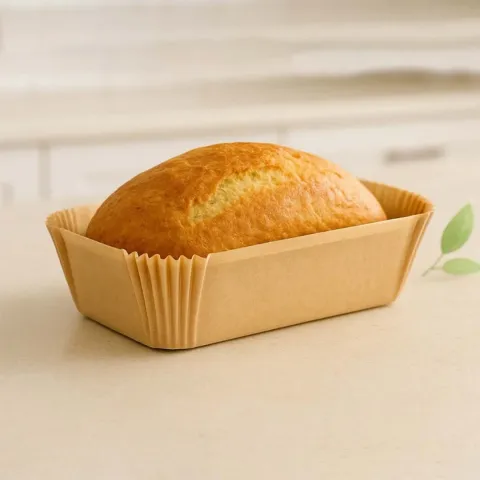
The rectangle has flat walls and the pleats are gathered into the corners, like a cake pan liner. That gives you four flat sides to lean a brownie slab against and corners that pull in rather than tear when you lift.
Rectangular liners also work cold. Delis use the 9 × 13 in size under a tray of sliced meats or a sandwich platter for exactly the reasons they use it hot. For loose paper in a serving basket rather than a formed tray, the greaseproof basket liners are the better fit.
Kraft, white or colored stock?
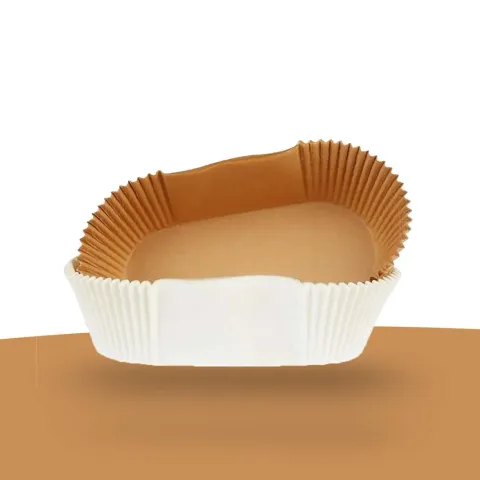
Kraft is the usual choice. It hides oil shine, looks right under wings and fries and photographs well in a delivery box. White is for bakeries, where a brownie edge against brown paper looks dull.
Colored stock, like the burgundy liner in the fourth photo, is a custom run. Ask on the quote if you want a house color on the shelf; the paper itself does the branding and no ink is needed.
Weight sits at about 35–45 lb, heavier than a loaf liner, because the trays are wider and have to hold a load of food flat while being lifted by the corners.
Can I print a logo on an air fryer liner?
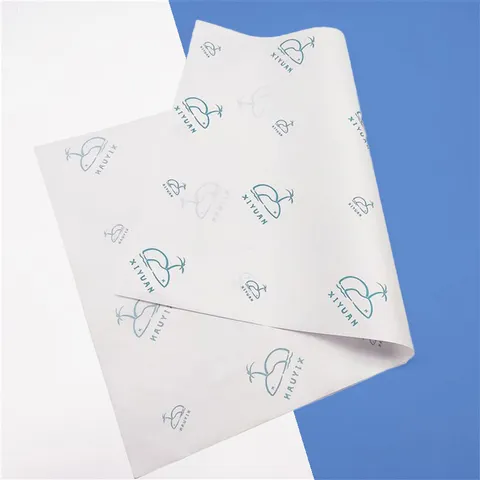
Yes, on the outer face of the walls. One dark color on kraft is the clean choice; the food covers the base, so the print goes on the wall band that shows above the food.
A small repeat mark every two inches survives the crimping better than a single large logo, which lands half in a crimp. The inks are food-safe soy and water-based and bake at the same temperature as the paper.
Lay it out on the wall band in Design Your Custom Tray Liners and we will send a proof that shows the crimp zones shaded.
Using tray liners for traybakes and sheet-pan meals
A 9 × 13 in rectangle turns a bare pan into a brownie pan with handles. The routine is the same for a sheet-pan dinner in the larger size.
- Drop the liner into the pan and press the base flat so the pleated corners open against the pan walls.
- Spread the batter or lay out the food to within half an inch of the wall; the walls hold it, but overfilling pushes the pleats outward.
- Bake at the recipe temperature, up to 400°F. The liner adds nothing to the time.
- Rest for a few minutes, then lift straight up by two opposite corners onto a board or into a box.
- Cut through the food, not the paper, and serve from the liner or slide the slab off it.
Mistakes to avoid with basket and tray liners
Nearly every complaint about a paper liner in a fryer traces back to one of these five habits.
- Preheating the fryer with an empty liner inside, which lets the fan lift it into the element.
- Using a liner whose walls are taller than the basket, so the rim folds over the food and steams it.
- Running them under a broiler or on a rack directly below a bare element, which is hotter than 400°F at the surface.
- Stacking wings above the wall height; anything above the rim is in the air stream and the paper offers it no protection.
- Reusing a liner after a glazed or saucy batch; the base is already caramelized and will scorch on the second run.
Packing and ordering
Liners come nested in stacks inside cartons, and they peel apart with a thumb at the corner. Minimum order is 1,000 liners of one size and stock.
To get a quote, send the floor measurement of your basket or pan, the wall height you want, and the stock. You will have a written quote within one business day, and payment is by invoice once the quote and any proof are approved.
Production takes 4–6 business days after approval. Tracked delivery to US addresses is free and takes 2–3 business days, and any damage reported within 10 days with photos is reprinted or refunded.