Your name on the wrap that goes into the customer's freezer
The last photo is the one to study. A frozen beef patty sits between two layers of white freezer paper, with the roll beside it and a sheet folded over the top. That is the paper's job, and the print goes on the face you can see.
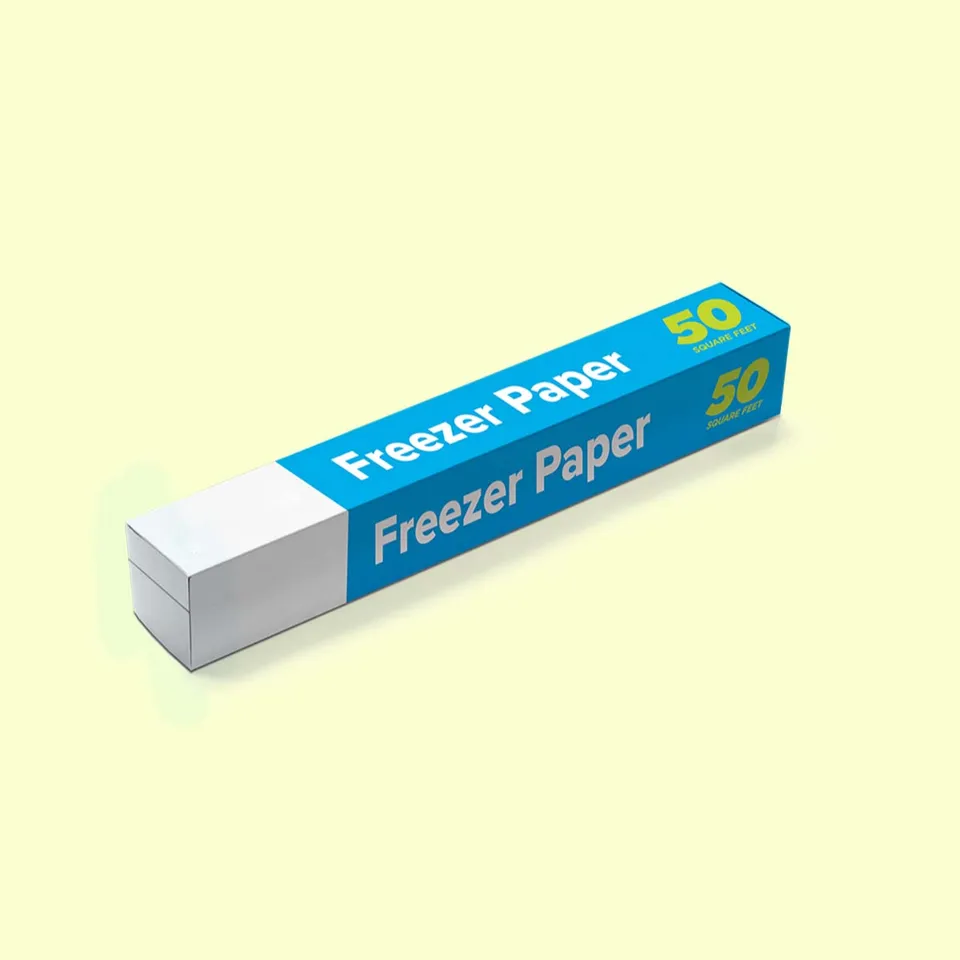
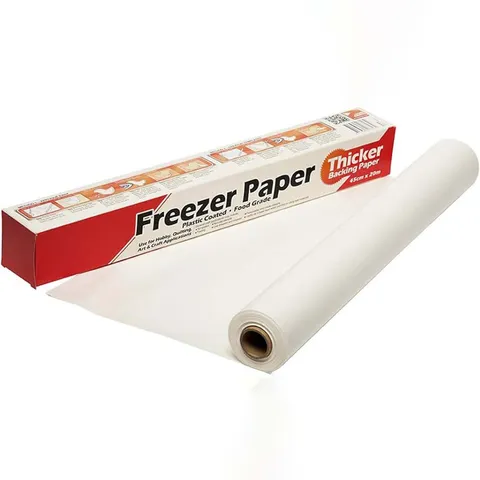
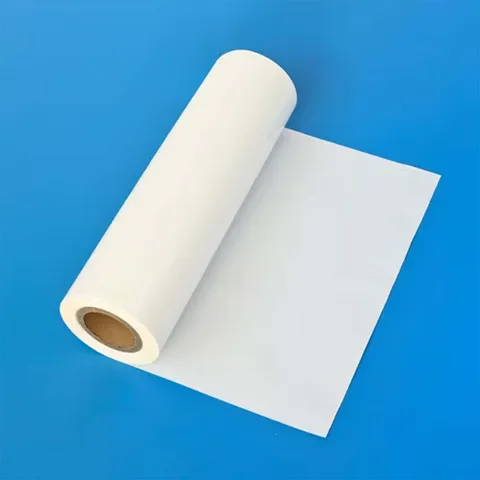
The other photos show the boxed format: a long carton with a sample design and a roll inside, pulled against a tear edge. Your artwork goes on the paper, not the carton, but the carton can carry a plain label with your name if you ask.
A plain wrap is forgotten the moment it is torn off. A printed one is in the customer's freezer for three months with your phone number facing out every time they open the lid.
Where does the print go on freezer paper?
On the paper face only. Freezer paper is coated on one side and bare on the other, and we print the bare side. When the package is wrapped with the film against the meat, the print is on the outside and nothing printed ever touches the food.
Rolls are wound with the printed face out, so as the sheet comes off the box the pattern is facing you and the film is facing the bench. Lay the meat on the film, fold, and the logo ends up outside without anyone thinking about it.
The inks are food-safe soy or water-based, dried and set before winding. They do not smear when a frosted package is handled, and they do not transfer to the shiny face of the next wrap on the roll.
Does the print hold at 0°F?
Yes. Cold does nothing to a dried ink. What spoils a printed package in a freezer is handling: frost rubbing against frost, a sharp bone corner, a package dragged out from under three others.
The heavy 40 to 45 lb sheet handles that better than a label. A stuck-on label lifts at the corner in a wet freezer and ends up on the floor; a printed sheet cannot peel.
Marker writing in the write-on panel also survives, as long as it was written before freezing. Ink on a frosted surface beads and wipes off, so tell the counter to label dry.
Which printed roll fits a farm-share packing table?
Pick width by the biggest cut you wrap often, not the biggest you ever wrap. A roast that comes once a month can take two sheets.
| Typical roll | Format | Where it works |
|---|
| 15 in × 150 ft | Boxed, tear edge | Farm store counter, chops and steaks, small fish market |
|---|
| 18 in × 150 ft | Boxed, tear edge | Butcher counter wrapping roasts, ground meat and poultry pieces |
|---|
| 18 in × 1,000 ft | Bulk on a core | Meat-box packing bench with a dispenser, CSA share assembly |
|---|
| 24 in × 1,000 ft | Bulk on a core | Whole chickens, primals, fish sides, deer and hog processing |
|---|
Boxed rolls are for counters without a dispenser. Bulk rolls are for benches with one. If you have a dispenser already, give us its bar diameter and the width between the end plates and we match the core and slit.
One color on white, or two?
White freezer paper is a clean canvas, so color choice is about contrast with meat and ice rather than with the paper. Black, forest green, navy and deep brown all read strongly through a frosted lid. A pale gray or yellow vanishes once a package has a dusting of frost.
One color is enough for most farms and butchers. A second color earns its place when the logo has two parts, say a name in black and a mark in green, or when you want the write-on panel in a lighter tint so the handwriting stands out.
Avoid red. On a package of raw beef, red ink reads as blood, and a customer opening the freezer cannot tell your logo from a leak. We say this on every freezer paper proof and it is the one color note we feel strongly about.
Pantone solid-coated matches are available for the colors that matter to the brand. Up to four colors can be printed, though on this paper nobody needs them.
A write-on panel for cut, weight and date
This is the design feature that separates printed freezer paper from a logo on a sheet. Print three ruled boxes labeled Cut, Weight and Date once in every repeat, and the counter has a label built into the wrap.
Space the panels so one lands on the outside of a typical package. On an 18 in roll a panel every 9 in means a chop-sized wrap shows at least one, and a roast shows two, one of which the wrapper fills.
Keep the panel ink light, a 20 percent tint of the main color, so black marker reads clearly over it. We lay the panel out on the proof and show it on a mock package so you can see where it falls after the fold.
If you want to try the layout first, drop the logo and panel into Design Your Custom Freezer Paper and send the result with the quote.
Roll build, weight and coating
The sheet is the same heavy white stock as plain freezer paper, about 40 to 45 lb, with the same thin plastic film on the inside. The print adds nothing to the thickness and changes nothing about how the paper folds or seals.
Boxed rolls at 150 ft come in a carton with a serrated edge. Bulk rolls at 1,000 ft come bare on a core for a dispenser. Both are wound print face out.
The film is for cold only. A printed sheet does not go on a smoker, in an oven or under a heat lamp, and the ink does not change that; it is the coating, not the print, that rules out heat.
- Boxed 150 ft, one color: a farm store or small butcher starting out
- Boxed 150 ft, two colors with a write-on panel: a counter that hands packages straight to customers
- Bulk 1,000 ft, one color repeat: a packing bench filling meat boxes all day
- Bulk 1,000 ft, edge stripe with panel: processors who wrap large cuts and want the print clear of the fold
Mistakes to avoid on a freezer paper print
The dense repeat is the first. A logo every 2 in looks busy on a 24 in sheet and wastes ink; every 5 to 6 in is enough, because a wrapped package shows several faces at once.
Fine type is the second. A phone number at 7 pt is readable on a flat proof and unreadable through frost on a folded package. Keep contact details at 12 pt or more and keep them in the clear, away from any tint panel.
The third is designing for the sheet rather than the package. Print a mock wrap on office paper, fold it round a block of wood the size of a roast and look at what shows. That ten-minute test fixes most layouts before the proof.
The fourth is forgetting the inside. Customers unfold the package and see the shiny face. It stays plain white, which is right, but if you expected print on both sides, know now that the film side cannot be printed.
How to order printed freezer paper
- Choose a width and format: 15 or 18 in boxed at 150 ft, or 18 or 24 in bulk at 1,000 ft, or give us a custom width.
- Upload a vector logo, say how many ink colors, and tell us if you want the write-on panel and what the three boxes should say.
- We send a written quote within one business day, showing one roll and a case so you can compare.
- Approve the quote and a free design proof follows, laid out as a strip of the roll and as a mock package; edits are unlimited.
- Approve the proof; printing and winding take 4 to 6 business days, and free tracked US delivery adds 2 to 3 business days.
- On arrival, pull a few feet and check the print; report a fault with photos inside 10 days and the roll is reprinted or refunded.
The minimum is one roll, and one printed roll is a fair trial for a counter. The printed freezer paper quote form asks for the roll size, the quantity and your file.